20
cfDNA | 1 mL – 20 mL
Revolution cfDNA Max 20 Kit
Cell-free DNA extraction from urine across sample inputs from 1 mL through 20 mL.
View in Kit SelectorBuild a recovery-focused liquid biopsy workflow around an abundant, non-invasive biological sample.
Urine is a non-invasive biological sample that contains multiple molecular components relevant to liquid biopsy, including DNA, RNA, extracellular vesicles, and cellular material.1 Urine-based liquid biopsy has been investigated in both urological and non-urological cancers.1,2
Unlike blood collection, urine can be collected non-invasively and in comparatively large quantities, making repeat sampling and larger-volume molecular workflows possible.1,2
For laboratories developing urine-based molecular assays, sample preparation determines how much of that available specimen can be processed and how much molecular material is successfully carried forward into downstream analysis.
Urine can be collected without a blood draw or invasive tissue procedure.
Urine provides flexibility for evaluating larger liquid biopsy inputs.
Urine contains cell-free and cell-associated molecular material.
As specimen input increases, conventional extraction approaches can require additional handling, transfers, processing units, pooling, or concentration steps.
Each additional manual operation can increase workflow complexity and create another opportunity for sample loss or variability. The Revolution workflow is designed to consolidate larger urine inputs into a more streamlined sample-preparation process.
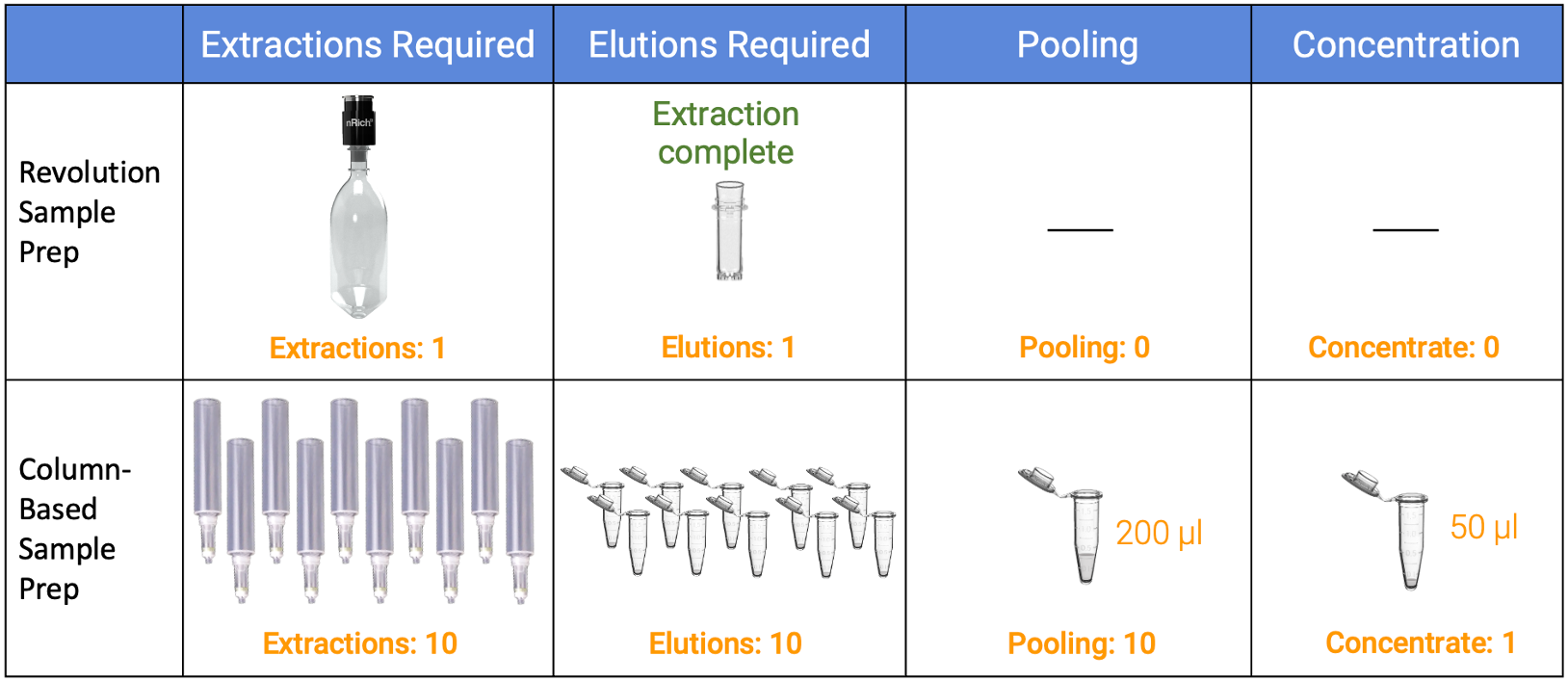
Urine contains cell-free nucleic acids in the supernatant as well as cellular material that can contribute DNA and RNA to downstream molecular analysis.3
In a 2026 nRichDX study, a whole-urine single-extraction workflow was compared with fractionated pellet and supernatant workflows under comparable extraction conditions.3
For low-abundance molecular targets, downstream analysis begins with the material successfully recovered during sample preparation. Sample input, analyte recovery, and transfer determine the molecular starting point available to the assay.
Current Revolution cfDNA and cfTNA kit configurations support urine sample inputs from 1 mL through 50 mL.
Select the analyte and sample-volume range that fits the workflow, then use the Revolution Kit Selector to identify the appropriate current configuration.
Cell-free DNA extraction from urine across sample inputs from 1 mL through 20 mL.
View in Kit SelectorCell-free DNA extraction from larger urine sample inputs greater than 20 mL and up to 50 mL.
View in Kit SelectorCell-free total nucleic acid extraction, including cfRNA, from urine inputs from 1 mL through 20 mL.
View in Kit SelectorCell-free total nucleic acid extraction from larger urine inputs greater than 20 mL and up to 50 mL.
View in Kit Selector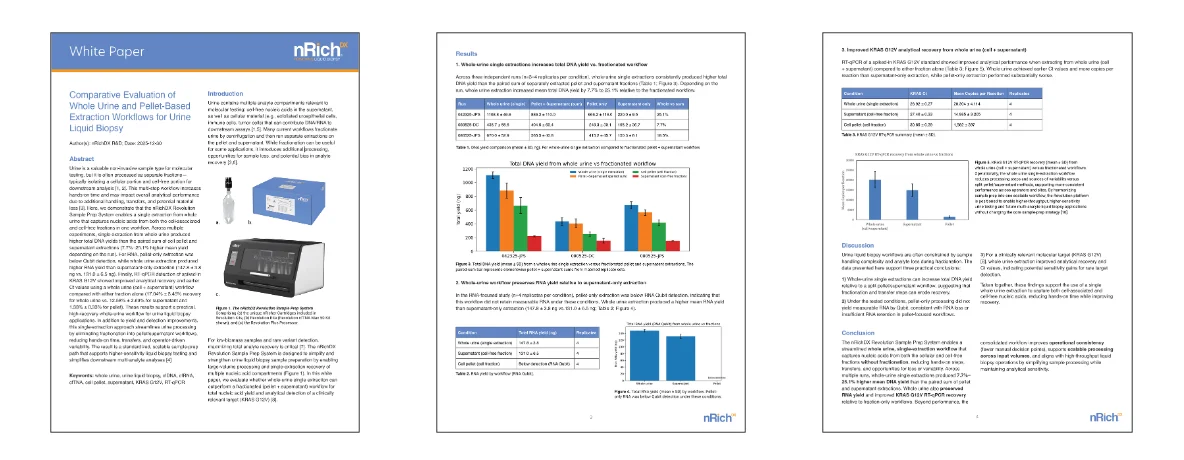
Explore a deeper discussion of whole-urine single extraction versus fractionated processing and the impact of simplifying upstream urine sample preparation.
The white paper expands on the workflow considerations behind processing whole urine and the opportunity to reduce unnecessary fractionation, transfers, and manual handling.
Explore posters, publications, application data, and collaborative studies spanning high-volume urine extraction, cfDNA, cfRNA, preservation, and downstream molecular analysis.