The Sensitivity
Ladder™
How much sample input does your assay really need?
The Sensitivity Ladder™ is an nRichDX-developed framework for empirically evaluating how sample input affects a defined assay endpoint, identifying where meaningful performance plateaus, and translating that learning into a reproducible workflow.
The framework does not assume that more sample is always better, does not claim that recovery alone determines sensitivity or specificity, and does not replace analytical or clinical validation.
Low-abundance signals make the upstream workflow matter.
In early-stage cancer and MRD, disease-associated molecular signal may be scarce before analysis even begins.
For teams developing MCED, single-cancer early detection, MRD, and other liquid-biopsy assays, downstream technologies can only analyze the molecular material that ultimately reaches the analytical workflow.
That makes the quantity and quality of molecular input important upstream variables. Sample volume, extraction recovery, analyte integrity, transfer into the assay, downstream chemistry, background, sequencing, and interpretation can all influence the final result.
Sample volume is only the beginning.
Molecular information moves through a series of biological, preanalytical, recovery, transfer, and analytical steps before becoming a measurable result.
Specimen volume, recovered analyte, assay input, analytical performance, and clinical performance are connected quantities, but they are not interchangeable.
More sample is not the strategy.
More sample may create additional molecular opportunity. It does not guarantee improved assay performance.
Increasing sample input may improve a selected endpoint, produce diminishing returns, have little meaningful effect, or introduce additional background, variability, inhibition, cost, sequencing demand, or workflow burden.
The purpose of an input study is therefore not to prove that larger volume is better. It is to measure the relationship that actually exists for the assay and workflow being developed.
The plateau is the decision.
As input increases, a selected performance endpoint may improve and then begin to level as another factor becomes limiting.
The scientifically useful region is where additional sample no longer produces a prespecified meaningful improvement in the endpoint being evaluated.
The candidate input can then be evaluated against specificity, background, reproducibility, sample quality, collection requirements, cost, and workflow practicality.
Evaluate. Measure. Optimize.
Standardize. Automate.
Turn sample input from an inherited workflow constraint into a controlled development variable.
Evaluate
Test a scientifically justified range of sample inputs under controlled and comparable conditions.
Measure
Follow recovered molecular material, the selected assay endpoint, background, reproducibility, invalid results, and operational behavior.
Optimize
Determine where additional input delivers meaningful value and identify the lowest input that enters the desired performance region.
Standardize
Define specimen input, processing requirements, elution conditions, quality controls, and relevant acceptance criteria.
Automate
Translate the selected workflow into repeatable execution appropriate for the intended laboratory environment and throughput.
Sensitivity cannot be optimized in isolation.
A useful input decision considers the entire controlled system rather than extraction yield or volume alone.
Determine whether increasing input produces a meaningful improvement in the endpoint defined for the study.
Evaluate whether additional input changes background, false-positive behavior, or other assay characteristics.
Consider how much usable molecular material reaches downstream analysis and whether it remains suitable for the intended assay.
Balance performance with collection, processing, throughput, cost, consistency, and operational practicality.
Prove the input.
Standardize the workflow.
Scale what works.
A scientific decision is only useful if the surrounding sample-preparation workflow can reproduce it.
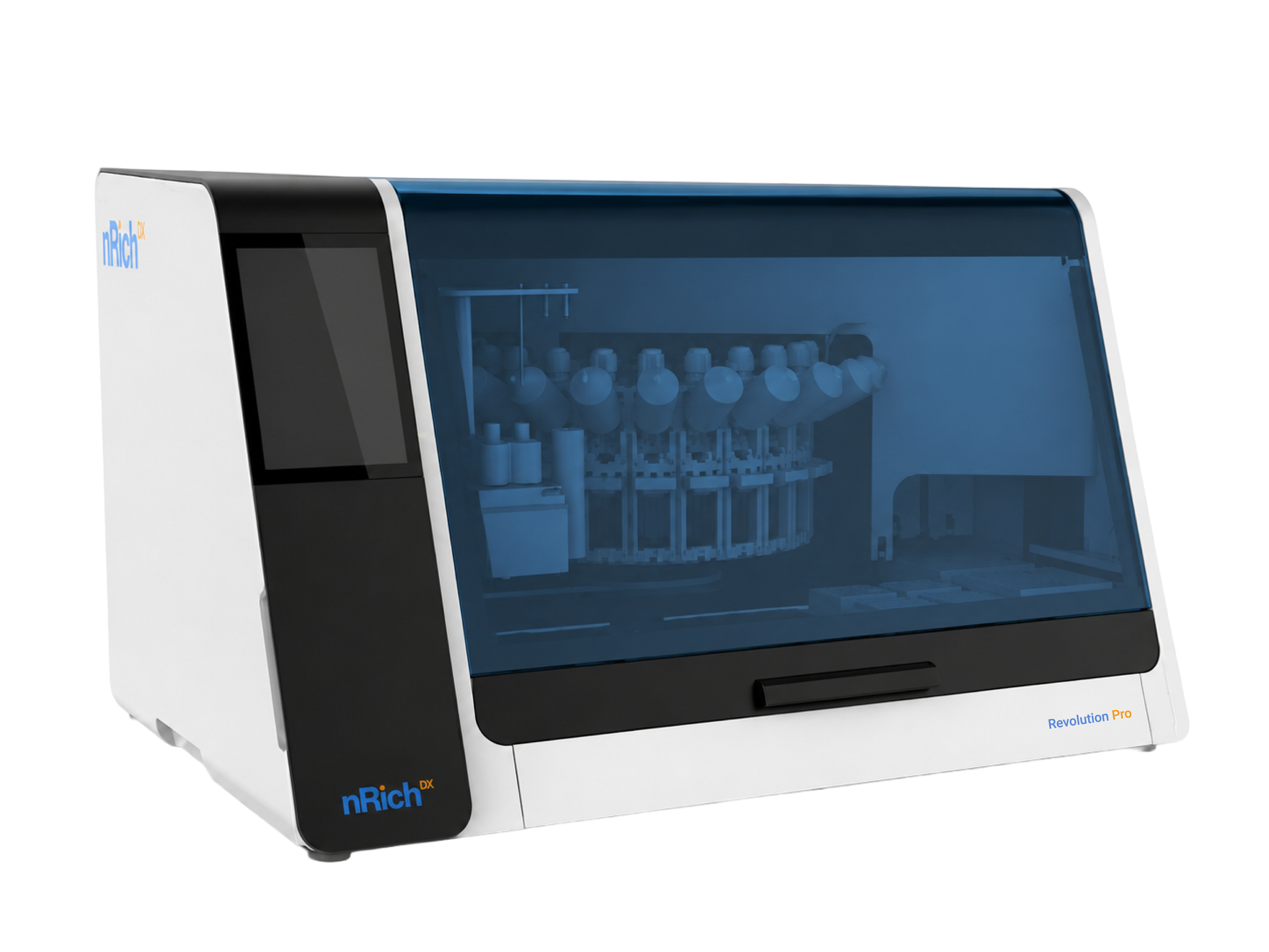
The Revolution Platform provides a path from flexible sample-preparation development into standardized and automated execution across supported liquid-biopsy workflows.
Measurement, not assumption.
The framework is intentionally bounded by what the data demonstrate.
The framework is designed to reveal the input-response relationship that actually exists.
Biology, preanalytics, recovery, molecular quality, downstream chemistry, background, sequencing, and interpretation can all contribute.
The framework helps evaluate an upstream development variable before analytical or clinical validation locks the workflow around an untested assumption.
Build the ladder.
Find the plateau.
Let’s evaluate where your assay reaches its optimal molecular input and how that workflow can be standardized.